Sunday, April 23, 2017

It was, I was, and I will be

Abort mission now. This will be long, drawn out, and most likely repetitive.

I'll never forget my first day as I anxiously searched for eyes that I knew so I could give a quick wave or a smile and feel like I wasn't alone in the crowd. I was so bent on not feeling alone because I believed that feeling alone was the worst thing that could possibly happen. I couldn't live the typical “homeschooler meets the real world” life of fear and bathroom stall lunches. I wanted to be known and loved but I wasn’t even sure who I was. I wanted to be different and selflessly love people but fear and insecurity quickly took over. I masked my insecurity of looking stupid with laughter at jokes I didn’t understand and trying my best to blend in.
My first two years of high school did prove successful academically and socially. However, I strayed from my mission to be true to myself and love people selflessly. My mission morphed into the pursuit of personal achievements, such as being well-liked, succeeding academically, and fitting in with the crowd. The problem was that I was focused inward rather than on how my individuality and ideas could serve others and the community. I might have continued on this path had I not decided to join the IB program. The IB program has both challenged me academically and encouraged me to think globally while allowing me to surround myself with fellow students who care for each other and love learning (mostly). Through the close relationshionships I have formed and the open discussions this closeness encourages, IB has helped me to recapture and refine my vision and my life mission.
Although I still strive for excellence, I would like the focus of my journey to be on continuing to develop my unique gifts, talents, and interests while truly appreciating and supporting others as they do the same. The beautiful thing about our world and society is that there are so many different ideas, opinions, and perspectives. I have learned to appreciate classmates and teachers who are different me. For me, appreciating and seeking to understand others is the key to building community and goes far beyond merely tolerating their beliefs and opinions. I believe that my background of a strong home school community, the reality check of navigating the performance pressure of high school, and the vision broadening impact of the Millbrook IB program has prepared me for this next stage of life.
My most impactful year has most certainly been senior year. There have been many difficulties yet at the end of the strife I feel more confident in who I am and what I want in terms of growth. My prayer for this year was this verse from Philippians 4:6-7 “Do not be anxious about anything, but in every situation, by prayer and petition, with thanksgiving, present your requests to God. And the peace of God, which transcends all understanding, will guard your hearts and your minds in Christ Jesus.”
Many nights, in heaps of tears, I scoffed and laughed at this call to live free of fear, fully thankful, and in perfect peace. How can my heart be guarded when it is already broken? How can I be thankful in a world full of failure and destruction? How can I be at peace when I am never enough? How can I not be full of anxiety when my life feels like a game of survival from deadline to deadline?
I can still smell the rancid powder that arouse from my airbag. I can still see the crying woman, the crunched metal, the warped tires, the shocked onlookers, and the still traffic - just for me... how special. I can still find the crumpled papers from universities that read only the repeated theme I told myself “You’re not good enough.” I remember the lost nights of self-loathing that my friends at school would never know of or possibly believe. I won’t say more so I don’t sound too dramatic (small aside about dramatic: Some days I revel in the label and other days I feel discredited by and bitter at the word that seems to be sewn on my back).
Dramatic aside, this year brought up many questions and formed memories both fond and foul. I have learned to look beyond myself and see that in everything God is good. This year has inspired me to look beyond temporary happiness and seek God that I might find joy in all circumstances rather than just those which I feel like reflect the beautiful things of life. But what are the good days without the bad days? What is light without the darkness? What is life without faith that there is more than simply what we can feel, touch, smell, and create to be our own truths?
I am no theologian and I cannot even begin to answer the many questions I have but at least I am asking them. Before I was afraid of doubt and how God could be real and good in a world full of suffering. Now I see that there is so much more than my small perspective on life and goodness. I am truly excited to move on more confidently and open as i understand the value of doubt and others perspectives on what it means to be human. Isn’t that the question we all secretly hold?
This blog post really shouldn’t have been left so open ended because I love to talk and write. I definitely need to wind down though and I applaud you if you have made is thus far.

I leave with this: my hope for the future.

I just want to live fully and vividly. I want to laugh long and know the shadow alongside me. I want to know myself and not fear solitude. I want to look at life like a marathon which does not repeat; each day is filled with new wonders. I want to stop to smell the flowers and still finish the race with flying colors. I no longer want to feel like my life is an endless climbing of a timeworn mountain and a falling into the same dark valley. I want to look deeply into the eyes of others and seek to know them and love them for that. I don’t want to keep seeking for perfection or arrival but to enjoy the run and learn how to acknowledge that the difficult times are what grow us.

Sunday, April 2, 2017

Walt Whitman's Notebook

Image result for chicken writing
https://lauraender.wordpress.com/


I have never been very skilled in the art of deciphering scribbles and chicken scratch - even when it’s my own writing. Therefore, this experience left me a little stressed and strained as I could barely make out any of the words. His writing is a downward-slant cursive that appears to be written in a rushed fashion. I’m sure one of the reasons for what appears to be careless cursive is that he wanted to quickly document his many ideas, inspirations, and thoughts so they couldn’t pass by to be forgotten before he could formulate them into a poem. In terms of his images, the first sketch of the profile of a man was honestly stunning and I was not expecting such detail in his drawings since his journal seemed to be the place he quickly placed his thoughts. However, the drawings became more strange until the last sketch which caught me off-guard. The last image of the skeleton with a heart as a body that has been stabbed through with a sword with the setting sun in the background left me curious and a bit uncomfortable. There is no telling for what exactly Whitman meant by this last image but I agree with the comments that it must be some sort of allegory either of America as a whole or possibly the society in a time where human rights were far from achieving equality.

I believe through a combination of Whitman’s writings and sketches, his inner thoughts are revealed to be darker and more scattered than the Whitman he reveals in his poetry. This makes sense in terms of his final product being a free verse style that seems to follow a rhythm only as long as his own thoughts adhered to the same cadence (rather than a poet fitting his thoughts into an accepted style and comfortable rhythm). His inner thoughts went beyond what he ever published for us to read today as his mind seemed to be constantly overwhelmed with creativity and reflection. Even the nature of an imaginary dialogue between himself and Lincoln takes a lot of creativity and reflection in how they would respond to one another.

As I read through the notes provided, I am now beginning to see the true content of Whitman’s words and I am fascinated by the link with the historical events unfolding to his writings. Whitman uses nature often in his poetry and I believe he uses the ship on rough waters to show the pursuit of liberty and justice in a divided America. Whitman’s journal becomes progressively distraught in terms of the division in America leading up to and during the Civil War. This is very reflective of his desire for universal brotherhood and his poetry that addresses the need for this unity and acceptance of all people since he sees what strife can be caused by brutally opposing one another. The water becomes more rough as the ship is tossed about which is connected with the approaching Civil War which was a very interesting aspect that I did not see before reading the notes. I was disappointed to learn that the sketches are not believed to be Whitman’s himself but it does make sense as it goes from such great detail to the strange picture he sketched himself of the skewered skeleton. This journal is significant because it contains an his outlet for the social strife and injustices that were happening around him. The fact that he had an imaginary conversation with Lincoln could also reveal that he wished to be more involved in making the change politically which he was able to feel by pretending to discuss the matters with Lincoln who could make the change happen.

Sunday, March 19, 2017

The American Dream: Are you there yet?

Image result for american dream
The “American Dream” is the opportunity and hope to achieve success and become another story of rags to riches. Success in terms of the dream is to become wealthy through hard work in what you love to do or whatever career you choose to pursue. When I hear the words “The American Dream,” I immediately picture an immigrant in the early 20th century spotting the statue of Liberty for the first time. I picture a smile of hope coming across their face as they imagine their life with a loving family and a well-paying job. The hope that they can make their fantasized American Dream come true that has continually pushed them on from whatever past they felt lacked potential for the unending comfort, prosperity, and opportunity this country seemed provided.
The idea of the American Dream was that you didn’t have to stay in socioeconomic status that you born into and that through your hard work you could become something great because all Americans deserve the opportunity of “life, liberty, and the pursuit of happiness.” The American Dream, as established through the Declaration of Independence, has been a motivation for great success and a bearer of sorrow through inflated expectations. In many cases, the American Dream has left participants battered and lost in a swirl of failed dreams and false hopes because the reality is that the perfect life of the American Dream doesn’t truly exist and that even those who seem to have achieved it are left wanting more.
The key phrase is “the pursuit of happiness” because it encompasses what Americans have construed into their right to wealth. Wealth is having an abundance of money, possessions, and power that comes from an advanced social status that money often provides. Wealth encapsulates those who live beyond comfortable and have extreme excess after attending to their daily needs. This creates a culture of entitlement as well as the ironic judgement of the wealthy which I believe can be seen in The Great Gatsby. The irony lies in the desire yet distaste for those who are excessively wealthy. From the very beginning, Nick claims that he is just a nice guy who doesn’t judge anyone yet Gatsby is the only person of such wealth that doesn’t disgust him. This shows that Nick does in fact judge those of wealth as he lives in the irony of having moved himself to New York to hopefully become wealthy. The whole context of F. Scott Fitzgerald's The Great Gatsby is this Roaring Twenties-style pursuit of wealth, status, and making it big in the big city. Nick is just another man in the thick of the play: a tragedy of wealth, love, and power. It is my opinion that despite his pleas of being an unbiased third party: he is another soul wound up in the hope of the American Dream.
In our culture today, I believe the pursuit of happiness via wealth is still a reality. However, there is also a big push for doing what you love despite the pay. This mimics the irony seen in The Great Gatsby because although our culture openly praises people for doing what they love, it continues to glorify the life of the rich and wealthy over the humble and simple lifestyle of those who may not make it rich in what they love to do. I believe that I am wrapped up in an American Dream of sorts. My dream comes from my encouragement to dream as I reach the end of one chapter of life and the next stage of becoming who I want to be when I grow up (I liked this question much better when I was 8). School has been pretty laid out for us until this point and now we are presented with options and choices; very expensive ones at that.
If I’m being honest, beyond college my dream is to wake up in the morning (at a reasonable hour) to a family that I adore, in a home that is my own, and to a job that has a meaningful impact on the community. However, the one thing I never want to happen is to become so focused on a dream that I fall into the endless greed of wealth and miss the beautiful moments of “the pursuit”. My true dream is that I will learn to live each day fully without getting stuck in my “American Dream” and becoming so invested in the future that I forget to live in the present. I think the biggest thing to realize is that money doesn’t provide happiness but neither do your circumstances. The college I choose to go to, my future job, and even my current days as a student that often feel purposeless and mundane should not be deciding my daily happiness. I guess my real dream is that I will learn to live life in this way that has eternal treasures rather than banking my happiness on the possessions and circumstances that will fade away.

Sunday, March 5, 2017

Sunday, February 19, 2017

The Struggle is Real: IOC Edition


A: Knowledge and Understanding of the Text and Extract
I'd give myself a 7-8 because I feel as though I referenced the historical context of the play as a whole and some of the holistic elements as well as the significance and content of my excerpt.
B:  Understanding of Use and Effects of Literary Features
I'd give myself a 5-6 because although I mentioned a lot of literary features, I feel like they lacked strength in terms of how I utilized textual evidence and the effect.
C: Organization
I'd give myself a 4 because I focused a lot on my organization but I sometimes let my brain wander in connecting thoughts on my paper when I was discussing my analysis out-loud. 
D: Language
I'd give myself a 3 which is mostly because I feel like I wasn't able to show my depth of understanding for the use of language. It's just frustrating because I feel like I try really hard but sometimes that makes me force a (weak) connection between the elements I see and what effects I see. I believe this is brought out in oral assessments as I am unable to look back and edit my lack of clarity.

Friday, February 3, 2017

Never Let Me Go: I judged the book by the cover


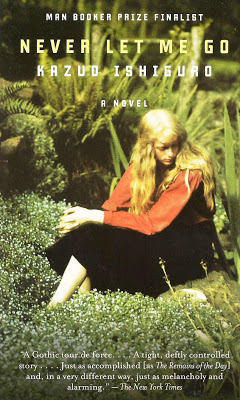
The four different Never Let Me Go covers represent the themes expressed in the novel with each highlighting different elements. The first cover on the top left shows a young girl with long hair sitting alone in the midst of little white flowers and greenery. The purpose of this cover is to display a peaceful scene but also a sense of alienation or isolation. This theme is also seen in the cover below with the lone boat tied to the dock in a foggy marsh. Both of these covers display a somber yet intriguing story to the reader for the purpose of highlighting the themes of humanity and alienation in the novel. I believe the covers on the right represent the contrast of the humanity of Kathy H., the narrator and protagonist, and her inhumane purpose of donations. Contrasting the cover with the girl in nature, the boat cover has not yet been physically represented in the book which leads me to believe that the boat is most importantly symbolism of the theme of isolation and alienation while the girl also shows the importance of relationships in the novel.

In fact, in all of the covers other than the boat, I see both the themes and where I feel the picture could relate to the actual content and plot of the novel. For example, although vague at first, the cover in the top right displays a blurred picture of a girl in a blue dress with an orange background. To me, the picture looks as though she is dancing which relates to the time that Kathy H. is seen dancing to her favorite song, Never Let Me Go. I believe the importance of this scene is that it shows the dilemma of children built for one purpose at Hailsham which is similar to the message seen in the first cover. Each child desires to engage with their humanity and interact in the world the same as any human. This cover contrasts with the covers on the right as it is blurry and more vague as to what it could be representing within the many themes of the novel. Finally, the cover in the bottom right is the most explicit with the dilemma at hand in the novel. The penciled outline of the upper body with displayed organs alludes to the donations and that the characters’ bodies are not their own. The purpose of this cover could be to show the audience that something is off about this story and to pick up quickly on the odd wording and phrases such as “carers” and “completion”. Another interesting element that I believe is referenced in the bottom two covers is the inability for the characters to escape their fate with the tied up boat and what looks like barbed wire outlining the exposed body.

Looking Deeper


The first words that come to mind when I see this image are the words: solitude, peace, romance, and loneliness. The girls positioning, surrounding, and long flowing hair make me think of Jane Austen novels and her time period. If I hadn’t read any of this novel I would have assumed the story was about a young girl in the late 18th century growing up as an orphan. I would have assumed that romance was the focus of the story and that perhaps in the midst of the blooming relationship with a local farm boy, the darkness from her family past comes to the surface and threatens the young lovers. Since I have read the novel, I believe this cover is depicting Kathy H. in a state of reflection within a cherished moment of solitude. Although she seems somber and possibly a bit melancholy, her body language is relaxed which adds to the peaceful setting of the vibrant surrounding nature. If Kathy H. is the one being displayed, we seem to be an outsider observing her moment alone. This could allude to the fact that personal escape is difficult to find in this dystopian society. However, another idea that comes to mind is that we could be the “you” that Kathy H. is writing to and referring to throughout the novel. This could then mean that we are a part of the society in some way and maybe even present in this moment that is pictured. This cover implies a Westernized cultural construction because the girl is white with light blonde hair and there is review for The New York Times on the front. I think this cover was most likely created by American publishers to create a relatable image with intrigue as the girl does stand out with her red shirt and light features. The title of the book on a cover like this makes it seem like a historical romance novel which appeals to young nostalgic readers as the teenage girl looks about their age with an air of mystique.


Perhaps I am just a hopeless romantic, but this cover also makes me think of romance. In addition to romance, the other words that come to mind are organs, tragedy, horror, and mystery. The reason romance first came to my mind is that the outline of the body with the title of the novel made me think of a Fault in Our Stars. So, at first I might assume the novel is a tragic love story of terminally ill teenagers. However, upon deeper analysis of the picture I might have seen the outline of the body in barbed wire and the light background of trees and what look like jail cell bars. This would have ultimately led me to believe that the story could be a personal account from a survivor of a concentration camp during World War II (possibly relating to the horrifying events surrounding Josef Mengele in Auschwitz). Knowing that this is not the case, I believe that the outlined body represents the donors as a whole and specifically Kathy H. and her friends from Hailsham. The perspective of the cover seems to of someone seeing the aftermath of the events in the novel. The cover screams urgency as the sketch of the body seems quick and focused on organs rather than detail followed by the title written like a cry for help. The cultural construction of this cover seems to centered around the science fiction side of the novel and for the appeal of the gothic literature culture. This cover seems that would be created by those who see the darker elements of donations and the dystopian setting as more important the relationships and coming of age story. The people that would read this kind of book would be those who are interested in science fiction and dystopian novels.

Sunday, January 22, 2017

The Inhumanity of Incomplete Storytelling


“The Danger of a Single Story”
Chimamanda Ngozi Adichie

I've always felt that it is impossible to engage properly with a place or a person without engaging with all of the stories of that place and that person. The consequence of the single story is this: It robs people of dignity. It makes our recognition of our equal humanity difficult. It emphasizes how we are different rather than how we are similar.
-Chimamanda Ngozi Adichie TEDGlobal 2009

Chimamanda Ngozi Adichie’s TED Talk called “The Danger of a Single Story” was truly inspiring and eye-opening as it addressed modern literature, culture, and humanity. Adichie’s main argument was that having a “single story” or one view of a place or a person is a limiting, inhuman way to live because it forms incomplete, flattened understanding. She opened with her childhood of reading Western literature and how it affected the way she understood literature. When she discovered African literature, she was freed from having a single story of what books were supposed to be. She learned that characters did not have to be foreign, but could in fact be about girls like her with “skin the color of chocolate.” Through her personal encounters as a Nigerian woman going to an American university, she stressed the important part of storytelling as being able to see both the good and the bad; the differences and similarities. In this, she discussed how Americans view Africa as a continent full of conflict, poverty, and starvation. While there are many problems such as these in Nigeria and other African nations, Adichie beckoned that there is also beauty and wonderful people doing amazing things that are glossed over in single stories. In the realm of storytelling, she discussed the role of power and how it affects how and when stories are told. Adichie claimed, “Power is the ability not just to tell the story of another person, but to make it the definitive story of that person.” When stories are told in singularity, stereotypes are not necessarily formed out of wrong information, but incomplete information. Adiche wrapped up with a call that “stories matter” and a reminder that “Stories have been used to dispossess and to malign, but stories can also be used to empower and to humanize.”

    Adichie is very poignant in getting her point across as she is blunt in the shortcomings of American culture without stepping on any toes by also explaining her similar experiences with a single story. From the very beginning, Adichie uses ethos to establish her credibility as an educated storyteller by referencing her childhood growing up on a university campus with highly educated parents. In addition to later attending an American university, she explained how she was reading and writing from a very young age which gave her credibility in terms of her experience with storytelling. She also utilized logos as she provided many examples and personal experiences with the consequences of both being the perpetrator and victim of a single story. Her roommate's idea of African women and her own view of Mexico were potent examples of how single stories deprive both parties of the beauty that could be found through storytelling if all aspects are presented: good and bad, base and beautiful. Finally, Adichie used pathos in her call for people to seek more than a single story as it relates to humanity as a whole. By showing the regained dignity and unity that storytelling can provide, she was able to tap into the emotional desire humans have for community and respect.

    “The Danger of a Single Story” is moving and powerful as it shows how storytelling can connect and empower people rather than divide. I picked this talk because it is honestly one of my favorite TED Talks because it is so real in addressing the tendency of humans to settle for single stories of people and places. I believe this issue is only getting worse as social media surrounds us with the “echo chamber” (as we discussed in TOK) and incomplete information that is taken as truth. I myself have fallen into the grasps of single stories as they are displayed at my fingertips as cheap, quick knowledge. As I reflect on this talk, I desire to stop cheating myself and others by viewing the world in this limited fashion. Storytelling is so important yet lost in our world of 140 characters or less. My minor complaint about modern culture aside, this TED talk really emphasizes how whole stories are beautiful and uniting, while fragments are limiting and dehumanizing. I feel like the concept that is most applicable in this case is the idea of lenses and perspectives. The benefit of the application of different perspectives such as Freudian, historical, gender, etc. in analysis is that it allows us to create a fuller picture that digs deeper into the story and adds dimensions. Perspectives defeat surface level analysis which is similar to the idea of a single story. Single stories are surface level because they do not display the numerous, beautiful dimensions of a people, place, or culture.

Sunday, January 8, 2017

The Man Behind the Slyish Cast

The two mysterious characters Jekyll and Hyde carry strange similarities and stark differences. In comparing Enfield’s description of Hyde and the description of Jekyll in chapter three, one similarity is the implication of a darkness within. The description of Hyde is much more straightforward in this as Enfield claims that “he gives a strong feeling of deformity” despite the fact that he cannot point out any physical deformities. This implies that there is a darkness within the character of Hyde that is displeasing to others as they sense something is wrong. In the same way, Jekyll hides something behind a “slyish cast” that is not as easily uncovered beneath his kind and caring demeanor. Additionally, when “young Hyde” is brought up by the lawyer, Jekyll’s face distorts from the previous handsome description to “pale to the very lips” with a “blackness about his eyes”. This again implies the dark connection between the two characters and this description of Jekyll could be seen as his face deforming to reveal the importance of appearance in mirroring the characters thoughts and feelings.
In contrast, Mr. Hyde is described in a vague and fearful manner. Enfield's active voice when describing Hyde consistently brings us back the strange subject of Mr. Hyde’s appearance and how that affects the way Mr. Enfield understands him. While also providing shorter sentences, active voice makes the subject, Mr. Hyde, take responsibility for the action of being deformed and displeasing. This is an interesting way to describe someone because Enfield is very direct about his views of Mr. Hyde rather than merely commenting on how the man seemed to be. Additionally, the description of his appearance remains steady in it’s horrifying nature and Enfield's inability to point out the reason for the horror. However, the voice and idea development of Dr. Jekyll’s character is spoken in a lengthy manner with fluid description. Dr. Jekyll is described in detail as “a large, well-made, smooth-faced man of fifty” as well as a man with “every mark of capacity and kindness.” This contrasts greatly with Hyde’s description of appearance because it implies a kind, honorable man while Hyde’s lack of physical description implies a mysterious figure as it remains the dark unknown. Another contrasting element is that the other characters around Dr. Jekyll and Mr. Hyde have very different responses. It is evident in Mr. Enfield’s characterization of Mr. Hyde that he is fearful of this negative creature and bothered by his inability to directly point out way he received such a negative, deformed feeling from Hyde. While Jekyll’s “slyish cast” is questioned, he is described in a much more positive manner to outsiders as “you could see by his looks that he cherished for Mr. Utterson a sincere and warm affection.” Such deep affection and sincerity is not even hinted at in Mr. Hyde’s personality.

Jekyll
I wake to the sunlight

I won’t fear to face them

I will pleasantly stroll with a smile
And hyde what can’t be seen


He is within me...
A weakness

He plucks at my sanity

I must rid myself of him

Yet
Hyde

I emerge in the moonlight

I won’t fear to face myself

I will freely roam as I am
And do as I please

He is within me...
A weakness

He tugs at my freedom

I must rid myself of him

He won’t.

The purpose of this poem is to show the opposing qualities of the two characters and foreshadow Hyde’s ultimate takeover of the two minds of one body. The intended effect is that the audience will see that ignoring the darker sides of us doesn’t solve the problem but can make them more appealing as something real rather than a societal mask. In a way, one could argue that displaying yourself as perfect was just as prevalent in the Victorian Era as it is now with social media. When nobody sees that you are hurting, nobody will know when you need help; just as Jekyll suffered with Hyde.

Sunday, December 18, 2016

Movie Night with Macduff

Macduff’s Recommendation List: Full of feels, honor, heartache, drama, and gore.
Most of these shows can be found on Netflix and Amazon Prime.

“She’s the Man”: For feels, honor, and encouragement.

“She’s the Man” is about a girl who pretends to be her brother to be able to play soccer when the girls soccer team is cut at her school. Macduff recommends this movie because of the way the lead actress breaks gender stereotypes and show the boys what she can do. He identifies with Viola Hastings (Amanda Bynes) when he is told he cannot do something because he is a man but he chooses to stay true to himself. He would also be inspired by the way Viola doesn’t accept her fate from those in charge but sneakily seeks justice undercover as Macduff does against Macbeth. We see Macduff's emotional side in this choice of movie as he approves of the idea of being yourself rather than fulfilling a stereotype. As Viola plays like a girl, Macduff feels like a man.

Related image

“Braveheart”: For the angry, emotional days

“Braveheart” is about William Wallace, a Scottish rebel, who leads a revolt against King Edward I of England when an English soldier executes his bride to be. Macduff recommends this movie to all of his friends because it is very similar to his own story and Macduff gets tired of telling it. Macduff empathizes with the tragic hero of William Wallace because he too lost his wife to an evil King. Macduff admires the main character's bravery and honor as he fights for his country and his loved ones. We see here that Macduff values both masculine strength and motivation through emotion and honor. Overall, this is a real tear jerker for Macduff but we see that he appreciates the historical accuracy, relatable characters, and the epic battle scenes. A perfect mix of the feels and masculinity..


Related image

“How I Met Your Mother”: A throwback heartache with a light touch

“How I Met Your Mother” is about a father recounting to his children, through a series of flashbacks, the journey he and his four best friends took leading up to him meeting their mother. Macduff used to recommend this tv show because he thought it was a really light and cute way to tell a sweet story like his own love story with his wife, Lady Macduff. However, after her and his family’s assassination, this one is a little harder to go back to because it just isn’t the same. Macduff still enjoys the dynamic characters as he sees a little bit of himself in all of them. There is also a bit of appearance vs. reality at play as the mystery unfolds of who the mother is and just when he thought he knew, he was wrong. Now Macduff especially enjoys the flashbacks because that is how he gets to experience his family since they are all dead. The flashbacks in the show make Macduff feel as though he can relive those wonderful days when he had a family.

Image result for how i met your mother gif

“Poldark”: For a little bit of everything

“Poldark” is a fantastic British tv show that follows the life of returned soldier Poldark and his life of rebuilding his family farm and restoring the family name. There is drama when his cousin marries his pre-war lover, romance with a new maid, brotherhood with hardworking pals, and all the excitement in between. Macduff loves this show as he gets to watch the noble Poldark rebuild his honor against high society despite being within it himself. Macduff relates to Poldark in this way as he seeks for what is best for all the people of his country rather than just himself (sadly, this lost Macduff his family but saylavee). Also, Poldark’s position as a man of high society makes him appear that he adheres to their ways when in reality he fights for the rights of the poor and lowly. Poldark is certainly a man of ambition like Macduff when it comes to doing the right thing.

Related image

“Grey’s Anatomy”: For overly dramatic feels and a nice night home alone (every night)

“Grey’s Anatomy” is an overly dramatic medical tv show interpretation of the surgical field at Seattle Grace Hospital in Washington. It follows a young surgeon named Meredith Grey and all the overly dramatic things that happen to her and her friends. This is Macduff’s guilty pleasure as he allows his manly emotion to emerge over this show with a bowl of popcorn and box of tissues in hand. This is a show full of blood and emotion with the full intensity that Macduff felt when he brought an end to the tyrant, Macbeth. Also Macduff finds a lot of similarities with the alliances and drama that is built within the hospital to that built within the castle during Macbeth’s reign.

Image result for grey's anatomy gif

Please comment or email Macduff@dunsinane.com for more information, inquiries, questions, words of encouragement, concerns, thank you notes, friend requests, and the like. He is alone now, after all. R.I.P Lady Macduff and fam.

Sunday, November 13, 2016

St. Thomas Becket's Shrine: Medieval-Day Disney World

Pilgrims Badge of the Shrine of St. Thomas Becket at Canterbury

Here we have a "Pilgrim's Badge of the Shrine of St. Thomas Becket at Canterbury" made between 1350 and the 1400s in Canterbury, England. These were most likely made by a Metalworker in Canterbury as a cheap souvenir for pilgrims. This bade was made from cast tin-lead alloy and is sized at 3 1/8 x 2 1/2 x 1/8in. Although, this particular artifact was specific to Canterbury, England as a part of Catholic British culture when St. Thomas Becket was murdered in his own cathedral by Henry VIII's men, pilgrims took these home to their loved ones across Europe. This piece would have represented the martyrdom of St. Thomas Becket and be a symbol of faith as people traveled hundreds of miles to pay tribute to a faithful servant of their God. It would have also represented the reverence for devote Catholics because of the beautiful detail of his shrine with jewel-encrusted tomb, baby cathedral arcs, and careful designs. I would compare this to a modern day postcard because it visually displays the sight of the pilgrimage that then pilgrims can bring home to their families to show a small representation of what the famous shrine looked like and serve as a mark that they had been there.

The author here use of color I think is chiefly due to the nature of the artifact as it is a souvenir that needed to be affordable for all travelers, therefore, it takes on the color of the dark metal/ pewter it was formed out of. The nature of this artifact being a badge leads the artist to work on a two-dimensional plane to show depth but within in the setting, there are three-dimensional elements to show the different aspects and details of the shrine. The rectangular shape and depth draw the eye to the center where St. Thomas Becket is represented with the most detail and three-dimensional qualities. This reinforces that the Saint is the center of attention and the reason for the pilgrimage as the ultimate symbol for the faithful. When holding this badge, pilgrims would feel the textured/raised elements such as the jewels and the martyr himself which would reinforce their importance where as the two other figures in the badge are fairly flat and unimportant. The form and shape of the badge enhance the meaning because it draws attention to the important elements where as a similar drawing in may not have been able to without color.

The purpose of this piece is to commemorate the martyrdom of St. Thomas A. Becket and honor the pilgrimage made by the faithful. In the time of the church split, the English people felt very convicted to display their faith and condemn those who thought differently. This badge was not only a religious claim but a social claim of their faith and boldness to pay tribute to a man murdered by their King. The title points out that as a badge, this artifact was like a trophy or medal for pilgrims, especially to those who traveled a long way, to show that they had indeed reached their destination as a faithful Catholic. Looking back on this piece, a modern historian would see that it also shows that such a pilgrimage in this time was not just for personal conviction, but a "great deed" to boast about. The meaning of this piece as a mark of honor and respect loses some of its weight when you see the social role that this souvenir would have played. Realizing that such souvenirs would have been sold at a Saint's shrine shows that pilgrims desired to have evidence that they had been there so people might think more highly of them and recognize them for their devote religious convictions. In addition, the presence of souvenirs at a shrine shows that the common people in England during this time had strong Catholic religious values, as they had enough people come through to sell such items. The value of this art in today's society is huge because it is one of the few visual displays that allows us to see what the shrine was like before it was plundered. Also the badge leads today's society to understand what the importance of the shrine might have been back then by comparing it to modern places that we acquire souvenirs to show our loved ones such as Disney World.

Image Right: http://www.metmuseum.org/toah/works-of-art/2001.310/
Image Left: My House by Me

Sunday, October 30, 2016

6. Writers often highlight the values of a culture or a society by using characters who are alienated from that culture or society because of gender, race, class, or creed. Explain how the character’s alienation reveals the surrounding society’s assumptions and moral values.

“Julia Severn, ma'am! And why has she, or any other, curled hair? Why, in defiance of every precept and principle of this house, does she conform to the world so openly--here in an evangelical, charitable establishment--as to wear her hair one mass of curls?"

"Julia's hair curls naturally," returned Miss Temple, still more quietly.

"Naturally! Yes, but we are not to conform to nature; I wish these girls to be the children of Grace: and why that abundance? I have again and again intimated that I desire the hair to be arranged closely, modestly, plainly. Miss Temple, that girl's hair must be cut off entirely; I will send a barber to-morrow: and I see others who have far too much of the excrescence--that tall girl, tell her to turn round. Tell all the first form to rise up and direct their faces to the wall."

This quote stood out to me for it's irony and ridiculous reasoning by Mr. Brocklehurst. I could not help but laugh the first time I read it when I realized he was speaking of her natural hair. I believe the author does this on purpose to point out to the reader the cultural issues at play. Here, his humorous denouncement of her naturally red and curly hair displays the values of the time.

The alienation of poor Julia Severn allows Austen to reveal to the reader quite plainly the values of a “evangelical, charitable establishment” in the 1840s. One distinguishing factor of this time period was the rigid modesty of both body and mind. Mr. Brocklehurst is seen as a hypocritical man as he uses the Bible for harsh punishments and ridiculous accusations, like Julia’s hair being immodest. Austen may then be using his alienation of Julia as a representation of the church in the Victorian Era. Julia’s hair, coupled with her low class, allows Mr. Brocklehurst to condemn her and the other girls with legalistic ideals that had become rampant in church theology to keep the lower classes in check. Mr. Brocklehurst remarks in a dogmatic tone, “why that abundance?”, which further supports that he believes girls of such low class should not pursue beauty or individuality. This is very similar to how the church, dogmatically manipulated by the wealthy class, called the low class to remain lowly and leave the beautiful things to those who can afford that kind of luxury.

This quote contains irony because Mr. Brocklehurst is seen claiming that the “good Christian way” is being overly modest so that you can be "children of Grace". However, if he truly believed in the Bible's teachings, then he would also believe that she is exactly how God created her to be. Therefore, God must also value beautiful things and that is how intended it to be. The irony of Julia's alienation shows that lower class society in the 1800s was diseased with the belief that pursuing beauty or just simply being different is immoral.

Sunday, October 16, 2016

Does your body look like her body?

This ad was released by Protein World in 2015 and has appeared in the U.K., where it is now banned, and New York City. The ad features a fit, lean, well-endowed, light skin women in grey-scale. She is wearing a bright yellow bathing suit and has long, light-colored and straight hair. On the yellow background, the phrase in bold across the ad is “ARE YOU BEACH BODY READY?” which is directly followed by “The weight loss collection” and three pictured Protein World products. It is also stated that these supplements will replace two meals daily. In addition, in the top left corner there social media icons and protein world’s @.
This add portrays avarice and envy as it insinuates that if you do not look like the women that is featured, that you are not beach body ready and need to look like her. They want people to buy their products and make people feel like they need more to become like that or maintain that beach body look. The result of greediness for these expensive supplements, most likely follows the initial envy of the woman’s body. The placement of the women on the ad makes it nearly impossible to look over her along with her black and white body in contrast to the bright yellow. This further insinuates that they want their audience to see her and react by buying their product. It is possible that they put the women in a grey-scale to neutralize her ethnicity but it is still clear that she is a light-skinned woman with light, straight hair, which is now causing the ad to not only be oppressive of women with different body shapes but also different races and ethnicities. Also, the direct following of the weight loss supplements to the question, show that Protein World assumes the answer is no and provides the audience an answer for their self-deprecating predicament.
The intended audience is young women, from teenagers to early thirties, in coastal North America and Europe, specifically the United Kingdom. The audience is most likely wealthy or middle-class as well as being busy as a student or at their job. This ad would appeal to busy young women because it suggests that they could lose weight from a meal replacement rather than a strenuous routine of diet and exercise. These young women are also most likely from privileged families who are able to afford a trip to the beach and that vacationing is still a part of their life agenda. I believe these women are well aware of how the media culture manipulates them to feel bad about themselves and make them feel like they aren’t enough but it still hurts. The reason these ads work to well-informed audiences is because, despite cultural knowledge about the negatives of our current society, people still want to feel accepted by looking the “right” way. When I look at this ad I know that it’s just the culture and they are trying to make me feel bad even though truthfully everyone is beach body ready, you just have to put on a bathing suit (maybe not even that in some places). However, it has already made me feel like I should hit the gym and fix myself so I can look better because it makes you feel like that is what society wants and that's what people want even if they say they accept you the way you are.
Source: http://www.cnbc.com/2015/07/01/protein-worlds-beach-body-ready-ad-not-offensive-watchdog.html

Thursday, September 29, 2016

What's in a Name?


Image result for what's in a name

My name, Amy Grace, is a combination of a family name and a southern tradition. Amy is the name of my late grandmother and my father's mother. She was a wonderful women and I remember her personally a little bit but I really know her through stories and others' memories of her. Amy also means beloved and that's certainly what she was and because she deserved to be revered. I think, therefore, having the name Amy for me has been something to embody, live up to, and a reminder to be someone she would be proud of to share her name. The Grace part of my name actually just comes from the idea of a double name that is really prevalent in my family tree. Grace by itself really doesnt give me much definition, but when it is paired with Amy, it becomes a big part of my indivuality. How many people do you know named Amy Grace? Hopefully very few, because my name has become one of the things that makes me feel unique. 

I believe Anna Quindlen hit right on the money with this statement. I may even take it a step farther to say there are many, many "me's" because there are so many layers to people. However, individual versus how you function in a whole are a very well simplified way to look at it. I see individual dilemmas as both more freeing and likely to come to an incorrect conclusion. The reason for this is that you feel comfortable mulling things over in your mind without being attacked by yourself but, sadly, that also means you don't get that input that you would have had in a group setting. While on the other hand, discussing topics in group can cause more conflict but also courage to step up and say something as well as a variety of ideas. When I am eating dinner at home with my family, I often feel like two people when we talk about controversial topics. Because they are my parents, I am not going to challenge them as much but I will still be thinking about whatever the topic may be the conversation piece. Another layer of that individual dilemma is that sometimes you feel or you know you are right and you need to go tell other people so they know you are right but you need a balance between telling someone because you care vs. fighting for what you think is right. 

(Image: https://blogger.googleusercontent.com/img/b/R29vZ2xl/AVvXsEj23J1SduCE0rhs26-iTV2Th2r6tS288jx8Kj5rSml4eEEwRX4aYiMX0KBuuwmtaWNVFAii8Q5CF6LPY9b2-SuP-BgV9gPEuoB5jzXfT6SthjeGpk9QvGiv5joBqRC6Vl70YC4nPO6tHxs/s1600/naming-your-business.jpg)